Probability Calculator
Unlock the power of prediction with our online probability calculator. Determine the likelihood of various events quickly and easily.
Result
| No of possible event that occured | ||
|---|---|---|
| No of possible event that do not occured |
Share on Social Media:
Probability helps predict and quantify outcomes. From data science to finance and daily decisions, probability guides understanding. webmastertool.site's Probability Calculator puts this power at your fingertips.
This guide explains the applications of probability. It also provides a plan for establishing the webmastertool.site calculator as a leading online resource. The plan includes a strategic international SEO framework.
The Broad Reach of Probability: More Than Just a Math Concept
Probability is a foundational concept. It influences numerous disciplines and aspects of life:
- Driving Data Science & Machine Learning: Probability is the basis of predictive analytics. It enables the development of models that forecast future events based on historical data. Probability is important for credit risk assessment, market trend prediction, and analyzing the effectiveness of data-driven models.
- Informing Financial Decisions: Probability helps in evaluating investment risks, optimizing portfolios, and guiding strategic choices in finance.
- Strengthening Engineering & Quality Control: Engineers use probability for reliability analysis. They assess the failure rates of systems and components. Also, they optimize quality control in manufacturing processes to minimize defects.
- Guiding Everyday Life: Probability influences everyday decisions. It helps in understanding the odds of winning a lottery, predicting weather changes, analyzing pricing strategies, and assessing health risks.
- Facilitating Education and Research: Probability calculators are valuable educational tools. They help students understand probability distributions and statistical concepts. In academic research, they support data analysis, sample size determination, and population distribution studies.
The Inner Workings of a Probability Calculator: A Detailed Guide
Probability calculators are invaluable online tools that simplify complex calculations related to the likelihood of events. While the specific interface might vary across platforms, the underlying principles and general workflow remain consistent. This guide provides a detailed explanation of how these calculators function and how users can effectively leverage them to understand and quantify uncertainty.
The Core Concept: From Inputs to Probability
At its heart, a probability calculator takes specific inputs from the user and, based on the type of probability being analyzed, applies relevant formulas to generate an output that quantifies the likelihood of an event occurring. This output is usually represented as a number between 0 and 1, where 0 signifies an impossible event and 1 signifies a certain event.
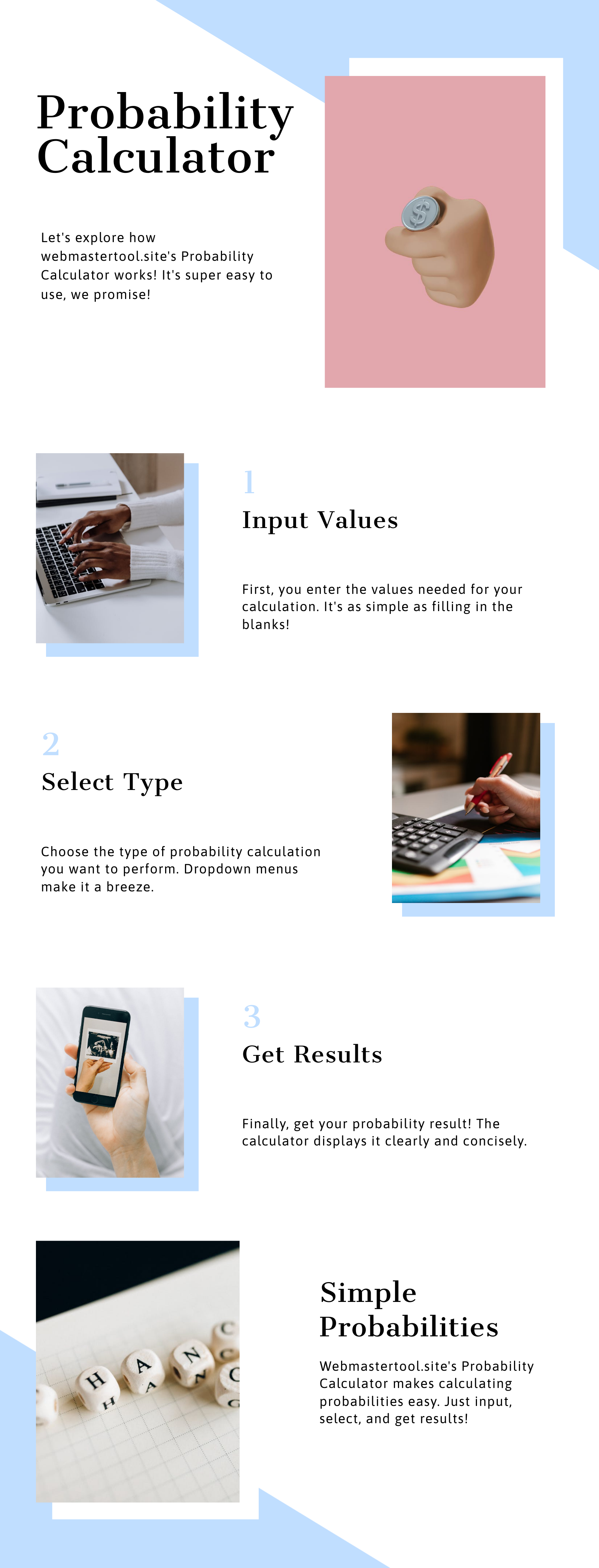
How a Typical Probability Calculator Works: A Step-by-Step Approach
- Defining the Problem: The initial step involves the user clearly defining the event or events whose probability they want to calculate. For example, calculating the probability of rolling a "6" on a six-sided die, or the probability of drawing a red card from a deck.
- Identifying Relevant Information: Based on the problem definition, the user needs to determine the necessary information to input into the calculator. This often includes:
- Number of Favorable Outcomes: The number of times the specific event of interest can occur. For example, when rolling a six-sided die, the number of favorable outcomes for rolling a "6" is 1.
- Total Number of Possible Outcomes (Sample Space): The total number of possible results or outcomes from the event. For example, when rolling a six-sided die, the total number of possible outcomes is 6.
- Probabilities of Individual Events: If the problem involves multiple events, the user might need to input the probability of each individual event occurring. For example, if determining the probability of both Event A and Event B happening, the calculator needs P(A) and P(B).
- Selecting the Probability Type/Scenario: Many calculators allow users to select the type of probability they wish to calculate from a dropdown menu. Options may include:
- Single Event Probability: The likelihood of a single outcome in one trial.
- Multiple Event Probability: The likelihood of several events occurring, possibly at the same time.
- Conditional Probability: The probability of an event happening given that another event has already occurred.
- Independent Events: Events where the outcome of one does not affect the probability of the other.
- Dependent Events: Events where the outcome of one affects the probability of the other.
- Mutually Exclusive Events: Events that cannot occur simultaneously.
- Inputting Values: Once the probability type is chosen, the calculator will provide corresponding input fields where the user enters the identified information (e.g., number of favorable outcomes, total outcomes, individual event probabilities).
- Calculation and Output: Upon entering the required information, the calculator automatically performs the necessary calculations using the appropriate probability formulas. The results are typically displayed as a fraction, decimal, or percentage.
Beyond Basic Calculations: Advanced Features
Many probability calculators offer additional functionalities to deepen understanding and address more complex scenarios:
- Step-by-Step Solutions: Some calculators provide detailed step-by-step solutions, helping users understand the calculation process.
- Probability Distribution Analysis: Advanced calculators might allow users to explore different probability distributions like the normal, binomial, Poisson, or geometric distributions. This functionality helps in understanding how probabilities are distributed across a range of outcomes.
- Visualization Tools: Some calculators present results graphically, such as histograms or probability density functions, for easier interpretation.
- Exploring Relationships: Some calculators can investigate the relationships between events. For example, it can calculate the probability of both events happening, only one happening, at least one happening, or neither happening.
Benefits of Using an Online Probability Calculator
- Ease of Use: Eliminates the need for manual calculations, making probability accessible even for those without advanced mathematical skills.
- Time-Efficiency: Provides quick and accurate probability estimations, saving time and effort, especially for complex scenarios or large datasets.
- Educational Value: Helps students and researchers visualize probability concepts and understand how they apply in real-world situations.
- Versatility: Supports various types of probability calculations, allowing for analysis of diverse scenarios from games of chance to risk assessment in business and finance.
- Accuracy: Reduces the risk of human error associated with manual calculations.
By understanding how probability calculators function and recognizing their capabilities, users can harness their predictive power. This empowers them to make more informed decisions in both personal and professional contexts, from everyday choices to complex statistical analyses.
webmastertool.site's Probability Calculator simplifies complex computations. It empowers individuals and organizations to make informed decisions in an uncertain world.